Du hast einen tollen Geschmack!
Melde dich an, um deinen Lieblingskünstlern zu folgen, Veranstaltungen zu speichern und vieles mehr.
Finde Tourdaten und Livemusik-Veranstaltungen für deine Lieblingsbands und -künstler in deiner Stadt. Hol dir mit Bandsintown Konzertkarten, erfahre Neuigkeiten und gib RSVPs zu Konzerten ab.

'%3e %3cpath d='M17.2 8.65233C17.2 3.87262 13.3508 0 8.6 0C3.84919 0 0 3.87262 0 8.65233C0 12.9785 3.12097 16.572 7.24758 17.2V11.1643H5.0629V8.65233H7.24758V6.76836C7.24758 4.60527 8.53065 3.38418 10.4726 3.38418C11.4435 3.38418 12.4145 3.55862 12.4145 3.55862V5.68682H11.3395C10.2645 5.68682 9.91774 6.3497 9.91774 7.04746V8.65233H12.3105L11.929 11.1643H9.91774V17.2C14.0444 16.572 17.2 12.9785 17.2 8.65233Z' fill='%236D6D6D'/%3e %3c/g%3e %3cdefs%3e %3cclipPath id='clip0_11991_110375'%3e %3crect width='17.2' height='17.2' fill='white'/%3e %3c/clipPath%3e %3c/defs%3e %3c/svg%3e)
'%3e %3cpath d='M13.546 0.716797H16.1835L10.4214 7.3954L17.2 16.4835H11.8924L7.73534 10.9716L2.97869 16.4835H0.339647L6.50272 9.33995L0 0.716797H5.44232L9.19996 5.75485L13.546 0.716797ZM12.6204 14.8825H14.0818L4.64822 2.23363H3.07994L12.6204 14.8825Z' fill='%236D6D6D'/%3e %3c/g%3e %3cdefs%3e %3cclipPath id='clip0_11991_110380'%3e %3crect width='17.2' height='17.2' fill='white'/%3e %3c/clipPath%3e %3c/defs%3e %3c/svg%3e)
'%3e %3cpath d='M8.6192 4.16563C6.16205 4.16563 4.20402 6.16205 4.20402 8.5808C4.20402 11.0379 6.16205 12.996 8.6192 12.996C11.0379 12.996 13.0344 11.0379 13.0344 8.5808C13.0344 6.16205 11.0379 4.16563 8.6192 4.16563ZM8.6192 11.4603C7.04509 11.4603 5.73973 10.1933 5.73973 8.5808C5.73973 7.0067 7.0067 5.73973 8.6192 5.73973C10.1933 5.73973 11.4603 7.0067 11.4603 8.5808C11.4603 10.1933 10.1933 11.4603 8.6192 11.4603ZM14.2246 4.01205C14.2246 4.58795 13.7638 5.04866 13.1879 5.04866C12.6121 5.04866 12.1513 4.58795 12.1513 4.01205C12.1513 3.43616 12.6121 2.97545 13.1879 2.97545C13.7638 2.97545 14.2246 3.43616 14.2246 4.01205ZM17.1424 5.04866C17.0656 3.66652 16.7585 2.43795 15.7603 1.43973C14.7621 0.441518 13.5335 0.134375 12.1513 0.0575893C10.7308 -0.0191964 6.4692 -0.0191964 5.04866 0.0575893C3.66652 0.134375 2.47634 0.441518 1.43973 1.43973C0.441518 2.43795 0.134375 3.66652 0.0575893 5.04866C-0.0191964 6.4692 -0.0191964 10.7308 0.0575893 12.1513C0.134375 13.5335 0.441518 14.7237 1.43973 15.7603C2.47634 16.7585 3.66652 17.0656 5.04866 17.1424C6.4692 17.2192 10.7308 17.2192 12.1513 17.1424C13.5335 17.0656 14.7621 16.7585 15.7603 15.7603C16.7585 14.7237 17.0656 13.5335 17.1424 12.1513C17.2192 10.7308 17.2192 6.4692 17.1424 5.04866ZM15.2996 13.6487C15.0308 14.4165 14.4165 14.9924 13.6871 15.2996C12.5353 15.7603 9.84777 15.6451 8.6192 15.6451C7.35223 15.6451 4.66473 15.7603 3.55134 15.2996C2.78348 14.9924 2.20759 14.4165 1.90045 13.6487C1.43973 12.5353 1.55491 9.84777 1.55491 8.5808C1.55491 7.35223 1.43973 4.66473 1.90045 3.51295C2.20759 2.78348 2.78348 2.20759 3.55134 1.90045C4.66473 1.43973 7.35223 1.55491 8.6192 1.55491C9.84777 1.55491 12.5353 1.43973 13.6871 1.90045C14.4165 2.1692 14.9924 2.78348 15.2996 3.51295C15.7603 4.66473 15.6451 7.35223 15.6451 8.5808C15.6451 9.84777 15.7603 12.5353 15.2996 13.6487Z' fill='%236D6D6D'/%3e %3c/g%3e %3cdefs%3e %3cclipPath id='clip0_11991_110387'%3e %3crect width='17.2' height='17.2' fill='white'/%3e %3c/clipPath%3e %3c/defs%3e %3c/svg%3e)


Künstler
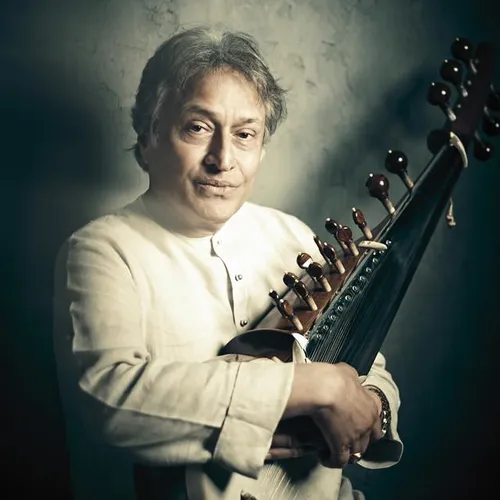
Amjad Ali Khan
Auf TourVerifiziert
3850 Follower•2 bevorstehende Shows
Keine demnächst stattfindenden Shows in deiner Stadt
Schicke eine Anfrage an Amjad Ali Khan, in deiner Stadt aufzutreten
Um eine Show bitten
Alle Ereignisse & Live-Übertragungen
Tour von Amjad Ali Khan
Außerdem folgen die Fans
Verpassen Sie nie wieder ein Amjad Ali Khan Konzert.
Erhalten Sie Benachrichtigungen über Tournee-Ankündigungen, Konzert-Tickets und Shows in Ihrer Nähe mit einem kostenlosen Bandsintown-Konto.
Über Amjad Ali Khan
Amjad Ali Khan
Ustad Amjad Ali Khan is a highly acclaimed Indian sarod player and composer.
Khan was born in Gwalior, Madhya Pradesh in 1945, is the sixth-generation sarod player in his family and his ancestors have developed and shaped the instrument over several hundred years. "You could say it's my family instrument", says Khan, "Whoever is playing the sarod today learned directly or indirectly from my forefathers."
His forefathers came from Afghanistan to India's relaxed music atmosphere and brought the Rabab which later developed into Sarod. The modern sarod has undergone modifications to improve its tonal quality, notably from Ustad Allauddin Khan and his brother Ayet Ali Khan of the Maihar Gharana.
Khan was taught by his father Hafiz Ali Khan, a musician to the royal family of Gwalior; he was born to the Bangash lineage rooted in the Senia Bangash School of music and is the sixth generation inheritor of this lineage.
Amjad Ali Khan has developed a unique style of playing the sarod. The key innovations in his style are compositions based on vocal music, the technical ability to play highly complex phrases (ekhara taans) on the sarod spanning three octaves and the emphasis on simple and elegant compositions. His technical mastery and control over his instrument is unsurpassed - a fact acknowledged by most musicians.
He has simplified the instrument by removing some strings (his sarod has only two jod and chikari strings and 11 tarab stings) and has also removed the resonant gourd (tumba) which is in use by other sarod schools. His base frequency is also lower than the other schools. His instrument is made by Hemen Sen of Kolkata, who also makes the sarod for other leading maestros such as Ali Akbar Khan.
His playing does reflect the older dhrupad tradition and he places emphasis on the conventional technique of "dara diri" using the wooden plectrum (java). However, his chief innovation is his ekhara taans (complex high speed phrases), something which many sarod players find very difficult to do. Paraphrasing his words "I asked my father why the sarod could not keep up with sitar when it came to taans....my father explained that the sarod was a much more difficult instrument to play, not having frets ... it is then I resolved to develop a style where I could match sitar like taans...".
Amjad Ali Khan has had a successful career spanning over 40 years and continues to be one of the busiest classical musicians in India. He was awarded India's second highest civilian award, the Padma Vibhushan in 2001.
Khan was born in Gwalior, Madhya Pradesh in 1945, is the sixth-generation sarod player in his family and his ancestors have developed and shaped the instrument over several hundred years. "You could say it's my family instrument", says Khan, "Whoever is playing the sarod today learned directly or indirectly from my forefathers."
His forefathers came from Afghanistan to India's relaxed music atmosphere and brought the Rabab which later developed into Sarod. The modern sarod has undergone modifications to improve its tonal quality, notably from Ustad Allauddin Khan and his brother Ayet Ali Khan of the Maihar Gharana.
Khan was taught by his father Hafiz Ali Khan, a musician to the royal family of Gwalior; he was born to the Bangash lineage rooted in the Senia Bangash School of music and is the sixth generation inheritor of this lineage.
Amjad Ali Khan has developed a unique style of playing the sarod. The key innovations in his style are compositions based on vocal music, the technical ability to play highly complex phrases (ekhara taans) on the sarod spanning three octaves and the emphasis on simple and elegant compositions. His technical mastery and control over his instrument is unsurpassed - a fact acknowledged by most musicians.
He has simplified the instrument by removing some strings (his sarod has only two jod and chikari strings and 11 tarab stings) and has also removed the resonant gourd (tumba) which is in use by other sarod schools. His base frequency is also lower than the other schools. His instrument is made by Hemen Sen of Kolkata, who also makes the sarod for other leading maestros such as Ali Akbar Khan.
His playing does reflect the older dhrupad tradition and he places emphasis on the conventional technique of "dara diri" using the wooden plectrum (java). However, his chief innovation is his ekhara taans (complex high speed phrases), something which many sarod players find very difficult to do. Paraphrasing his words "I asked my father why the sarod could not keep up with sitar when it came to taans....my father explained that the sarod was a much more difficult instrument to play, not having frets ... it is then I resolved to develop a style where I could match sitar like taans...".
Amjad Ali Khan has had a successful career spanning over 40 years and continues to be one of the busiest classical musicians in India. He was awarded India's second highest civilian award, the Padma Vibhushan in 2001.
Mehr anzeigen
Keine demnächst stattfindenden Shows in deiner Stadt
Schicke eine Anfrage an Amjad Ali Khan, in deiner Stadt aufzutreten
Um eine Show bitten
Alle Ereignisse & Live-Übertragungen
Tour von Amjad Ali Khan
Über Amjad Ali Khan
Amjad Ali Khan
Ustad Amjad Ali Khan is a highly acclaimed Indian sarod player and composer.
Khan was born in Gwalior, Madhya Pradesh in 1945, is the sixth-generation sarod player in his family and his ancestors have developed and shaped the instrument over several hundred years. "You could say it's my family instrument", says Khan, "Whoever is playing the sarod today learned directly or indirectly from my forefathers."
His forefathers came from Afghanistan to India's relaxed music atmosphere and brought the Rabab which later developed into Sarod. The modern sarod has undergone modifications to improve its tonal quality, notably from Ustad Allauddin Khan and his brother Ayet Ali Khan of the Maihar Gharana.
Khan was taught by his father Hafiz Ali Khan, a musician to the royal family of Gwalior; he was born to the Bangash lineage rooted in the Senia Bangash School of music and is the sixth generation inheritor of this lineage.
Amjad Ali Khan has developed a unique style of playing the sarod. The key innovations in his style are compositions based on vocal music, the technical ability to play highly complex phrases (ekhara taans) on the sarod spanning three octaves and the emphasis on simple and elegant compositions. His technical mastery and control over his instrument is unsurpassed - a fact acknowledged by most musicians.
He has simplified the instrument by removing some strings (his sarod has only two jod and chikari strings and 11 tarab stings) and has also removed the resonant gourd (tumba) which is in use by other sarod schools. His base frequency is also lower than the other schools. His instrument is made by Hemen Sen of Kolkata, who also makes the sarod for other leading maestros such as Ali Akbar Khan.
His playing does reflect the older dhrupad tradition and he places emphasis on the conventional technique of "dara diri" using the wooden plectrum (java). However, his chief innovation is his ekhara taans (complex high speed phrases), something which many sarod players find very difficult to do. Paraphrasing his words "I asked my father why the sarod could not keep up with sitar when it came to taans....my father explained that the sarod was a much more difficult instrument to play, not having frets ... it is then I resolved to develop a style where I could match sitar like taans...".
Amjad Ali Khan has had a successful career spanning over 40 years and continues to be one of the busiest classical musicians in India. He was awarded India's second highest civilian award, the Padma Vibhushan in 2001.
Khan was born in Gwalior, Madhya Pradesh in 1945, is the sixth-generation sarod player in his family and his ancestors have developed and shaped the instrument over several hundred years. "You could say it's my family instrument", says Khan, "Whoever is playing the sarod today learned directly or indirectly from my forefathers."
His forefathers came from Afghanistan to India's relaxed music atmosphere and brought the Rabab which later developed into Sarod. The modern sarod has undergone modifications to improve its tonal quality, notably from Ustad Allauddin Khan and his brother Ayet Ali Khan of the Maihar Gharana.
Khan was taught by his father Hafiz Ali Khan, a musician to the royal family of Gwalior; he was born to the Bangash lineage rooted in the Senia Bangash School of music and is the sixth generation inheritor of this lineage.
Amjad Ali Khan has developed a unique style of playing the sarod. The key innovations in his style are compositions based on vocal music, the technical ability to play highly complex phrases (ekhara taans) on the sarod spanning three octaves and the emphasis on simple and elegant compositions. His technical mastery and control over his instrument is unsurpassed - a fact acknowledged by most musicians.
He has simplified the instrument by removing some strings (his sarod has only two jod and chikari strings and 11 tarab stings) and has also removed the resonant gourd (tumba) which is in use by other sarod schools. His base frequency is also lower than the other schools. His instrument is made by Hemen Sen of Kolkata, who also makes the sarod for other leading maestros such as Ali Akbar Khan.
His playing does reflect the older dhrupad tradition and he places emphasis on the conventional technique of "dara diri" using the wooden plectrum (java). However, his chief innovation is his ekhara taans (complex high speed phrases), something which many sarod players find very difficult to do. Paraphrasing his words "I asked my father why the sarod could not keep up with sitar when it came to taans....my father explained that the sarod was a much more difficult instrument to play, not having frets ... it is then I resolved to develop a style where I could match sitar like taans...".
Amjad Ali Khan has had a successful career spanning over 40 years and continues to be one of the busiest classical musicians in India. He was awarded India's second highest civilian award, the Padma Vibhushan in 2001.
Mehr anzeigen
Außerdem folgen die Fans
Verpassen Sie nie wieder ein Amjad Ali Khan Konzert.
Erhalten Sie Benachrichtigungen über Tournee-Ankündigungen, Konzert-Tickets und Shows in Ihrer Nähe mit einem kostenlosen Bandsintown-Konto.
Genieße mit der App Bandsintown das ganze Erlebnis.

Live-Fotos

Live-Fotos